The Hidden Cost of Inefficient Pump Systems
EFFICIENCY BEFORE FUEL · SERIES POST 10 · WEEK 17 Part III · APRIL 2026
Why Auxiliary Pumps Are Quietly Eroding Your Margins, and How VFD Retrofits Deliver the Highest ROI in the Drydock Package
Maritime Industry | Pump Efficiency | VFD Retrofit Economics | René Grywnow, DBA
Every day a vessel operates with fixed-speed pumps controlled by throttling valves, it is paying for energy it does not use. The throttling valve does not reduce the motor's energy consumption, it converts excess flow into heat and pressure drop, discarding the energy as waste. This is not a minor inefficiency. It is a structural loss embedded in the auxiliary system design of most vessels currently in service, and it costs operators millions over a vessel's operating life while generating zero commercial output.
EXECUTIVE SUMMARY
Pumping systems account for up to 50% of a vessel's auxiliary electrical load. When operated at fixed speed with throttling control, the default configuration on most vessels in service, 50–70% of pump energy is wasted at typical partial-load operating points (University of Piraeus, 2025).
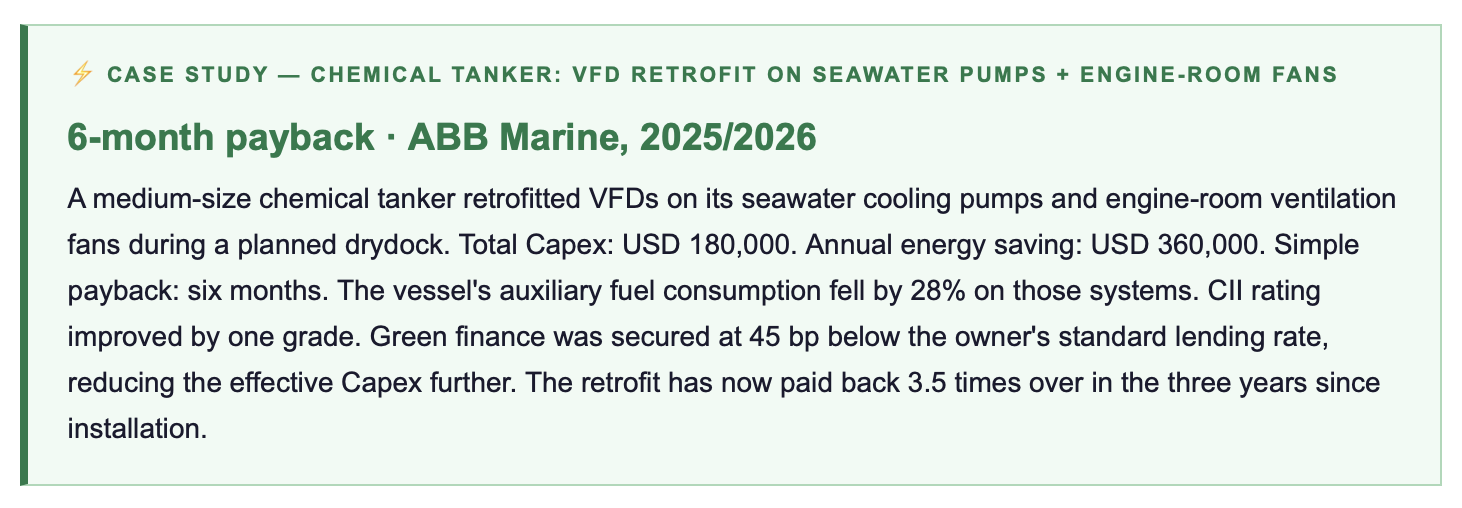
Variable Frequency Drives (VFDs) paired with IE4/IE5 high-efficiency motors eliminate this waste by matching motor speed to actual load. Verified savings: 20–60% on individual pump systems, translating to 1–5%+ reduction in overall vessel fuel consumption. Real-world payback as short as six months (ABB, 2025/2026).
Pump and motor upgrades are the highest-ROI component of any combined drydock efficiency package: lowest Capex-to-saving ratio, shortest payback, zero fuel infrastructure dependency, and immediate measurable savings from the first day of operation. Capex range USD 200–500 per installed HP.

1. The Scale of the Problem: Paying for Energy You Never Use
Most vessels in commercial service were designed and built with a control philosophy that made engineering sense in an era when energy was cheap and variable-speed drives were expensive: run the pump at full speed and use a throttling valve to control flow. The valve restricts the flow by introducing a pressure drop across itself,and the energy used to overcome that pressure drop is dissipated as heat. The motor keeps running at full power. The useful work delivered decreases. The energy bill stays the same.
This is the maritime equivalent of driving at full throttle with the handbrake on and using the brake to control speed. It is not a metaphor, it is a physically accurate description of what happens inside the auxiliary system of most tankers, bulk carriers, and containerships currently trading.
The scale of the problem is significant. For a mid-size vessel (Panamax 65,000 DWT), auxiliary electrical load runs at approximately 1.5–2.0 MW under normal operating conditions. Pumping systems, ballast pumps, seawater cooling pumps, fire/GS pumps, and engine-room service pumps, account for 40–55% of that load: 600–1,100 kW running continuously at sea. At typical partial-load operating points (60–80% of rated flow), throttling control wastes 50–70% of that energy, between 300 and 770 kW discharged as heat through throttling valves, on every operating day of the vessel's life.
Converted to fuel: a Panamax auxiliary system wastes approximately 400–1,000 MT of fuel per year through pump inefficiency alone. At USD 620/MT, that is USD 250,000–620,000 in annual fuel spend producing zero commercial output. Over a ten-year operating life: USD 2.5–6.2 million discarded through throttling valves.
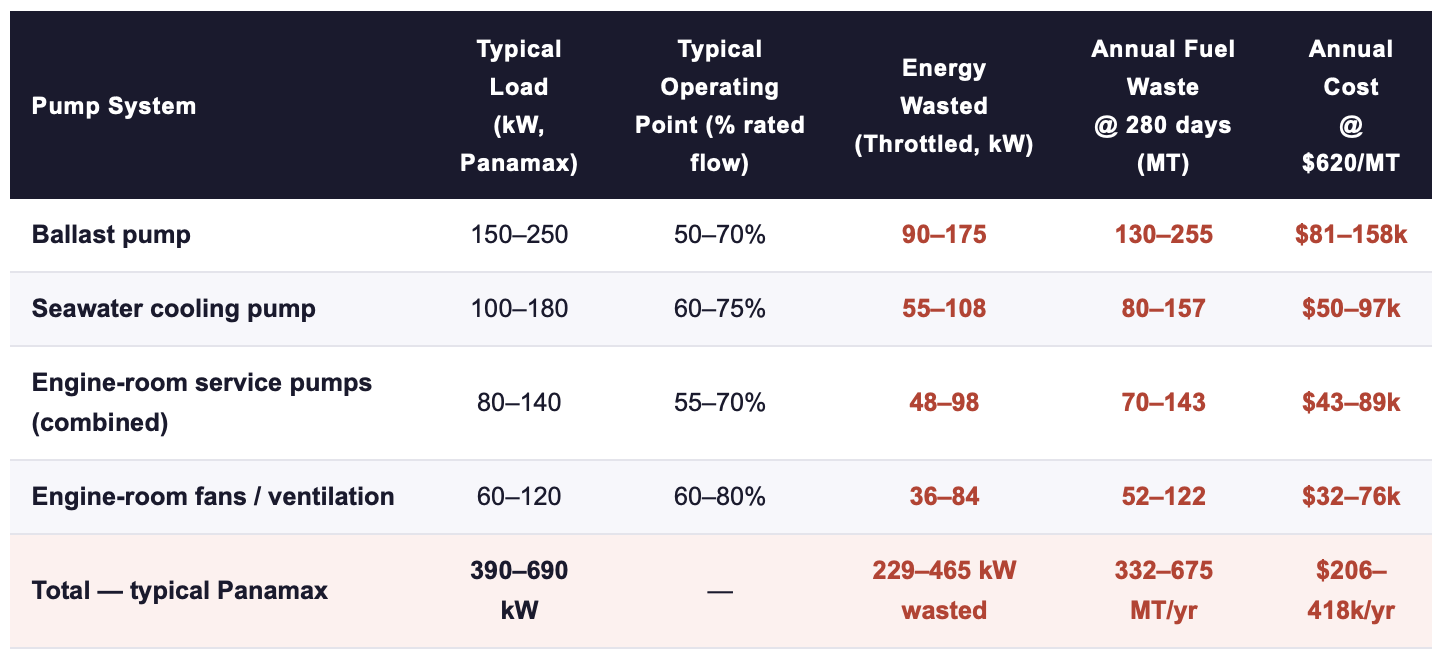
Estimates based on University of Piraeus ballast pump VFD study, 2025; ABB Marine case study data, 2025/2026; ABS auxiliary system efficiency benchmarks, 2025. Fuel equivalent calculated at 180 g/kWh SFOC for auxiliary diesel generators.
👉 Key Insight: A Panamax operator with throttled pump control is spending USD 200,000–420,000 per year on fuel that produces no propulsive output, no commercial cargo movement, and no regulatory compliance benefit. It is pure waste, and it is structurally built into the system design. VFD retrofit does not improve the pump. It stops paying for energy the pump does not need.
2. The Physics and the Hard Numbers: Why VFDs Work So Well
The reason VFDs deliver such dramatic savings is not engineering novelty, it is the Affinity Laws, a set of fluid dynamic relationships that have been understood for over a century. The Affinity Laws govern the relationship between pump speed, flow, pressure head, and power consumption in centrifugal pump systems. Their consequence for maritime energy efficiency is profound.
THE AFFINITY LAWS: WHY HALVING SPEED SAVES 87.5% OF POWER
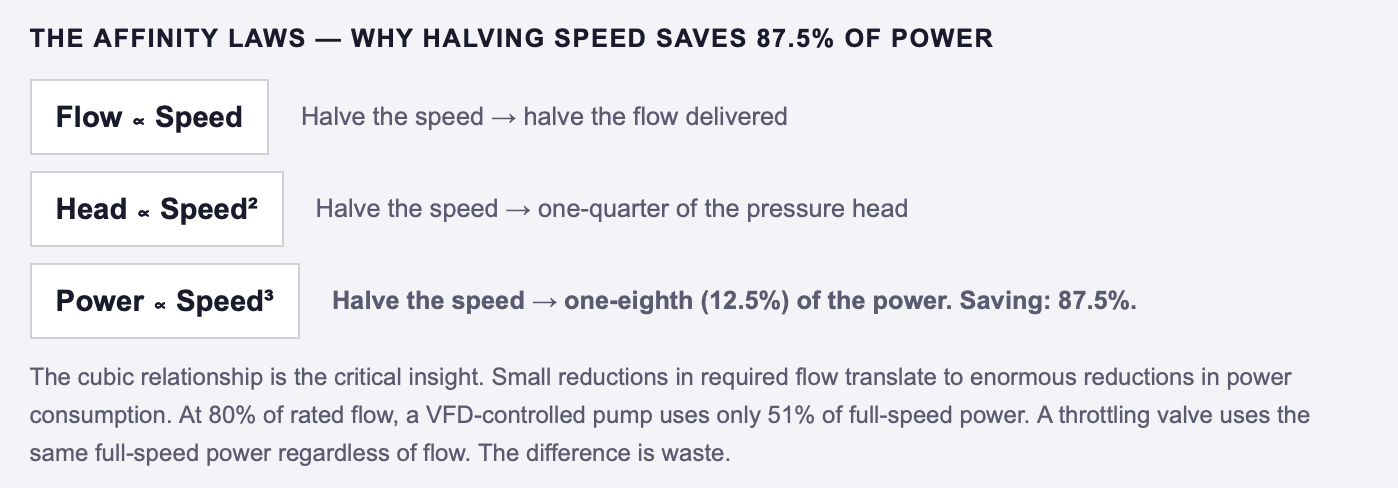
The cubic relationship is the critical insight. Small reductions in required flow translate to enormous reductions in power consumption. At 80% of rated flow, a VFD-controlled pump uses only 51% of full-speed power. A throttling valve uses the same full-speed power regardless of flow. The difference is waste.
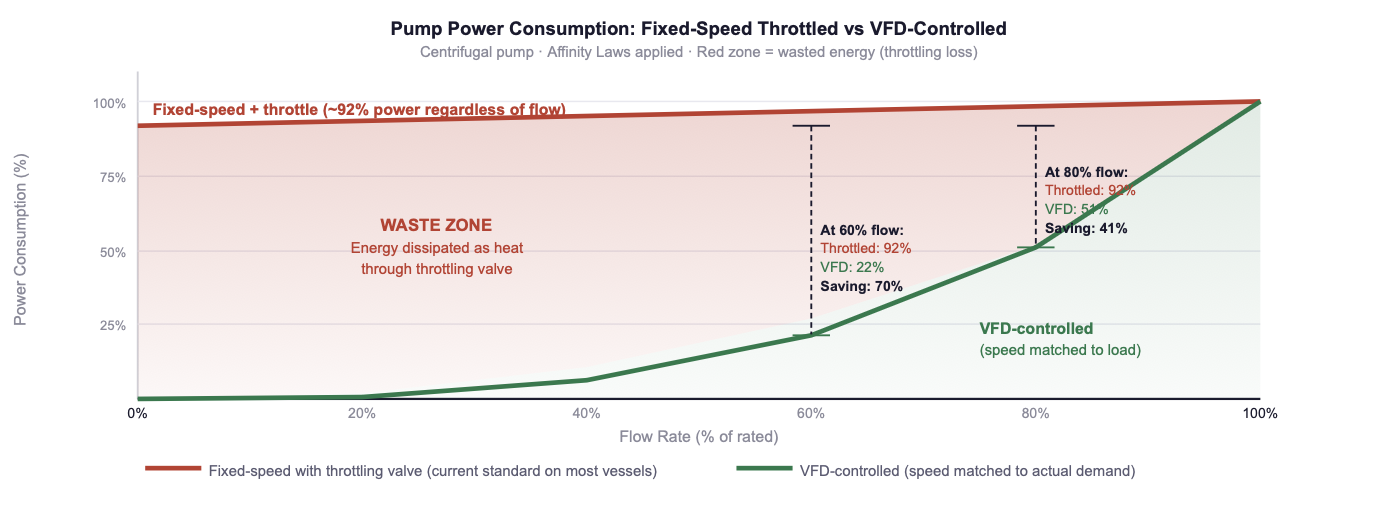
Fig. 1: The red zone is wasted energy. At 60% flow, throttled control consumes 92% of rated power; VFD control consumes 22%, a 70% saving at that operating point. Most ballast and cooling pumps operate between 55–80% of rated flow for the majority of their running hours. Sources: University of Piraeus, 2025; ABB Marine, 2026; Affinity Laws (fluid dynamics).
The chart illustrates why the University of Piraeus (2025) study found 50–70% energy savings on ballast and seawater cooling pumps: those systems typically operate at 55–75% of rated flow, precisely the range where the gap between the fixed-speed line and the VFD curve is largest. The physics are not uncertain. The savings are not marginal. The question is only whether the motor is matched to the load or running against a valve.
👉 Key Insight: The Affinity Laws make pump VFD retrofits structurally different from most efficiency investments, the savings are governed by physics, not by market conditions, bunker prices, or infrastructure availability. At 60% flow, the saving is 70%. Always. That predictability is what makes pump and motor upgrades the most reliable component in any combined drydock efficiency package.
3. IE4/IE5 Motor Efficiency: The Second Layer of Savings
VFDs eliminate throttling waste. IE4/IE5 high-efficiency motors eliminate conversion losses within the motor itself. The two technologies address different points in the energy chain, VFDs at the system control level, high-efficiency motors at the electromechanical conversion level, and their savings are additive when installed together.
The majority of vessels currently in service run IE2-class motors, which were the standard specification at time of build. IE2 motors operate at 89–91% electromechanical efficiency. IE4 motors achieve 94–95%; IE5 (ultra-premium) reaches 96–97%. The difference sounds small. At the energy consumption scale of a large vessel, it is not.
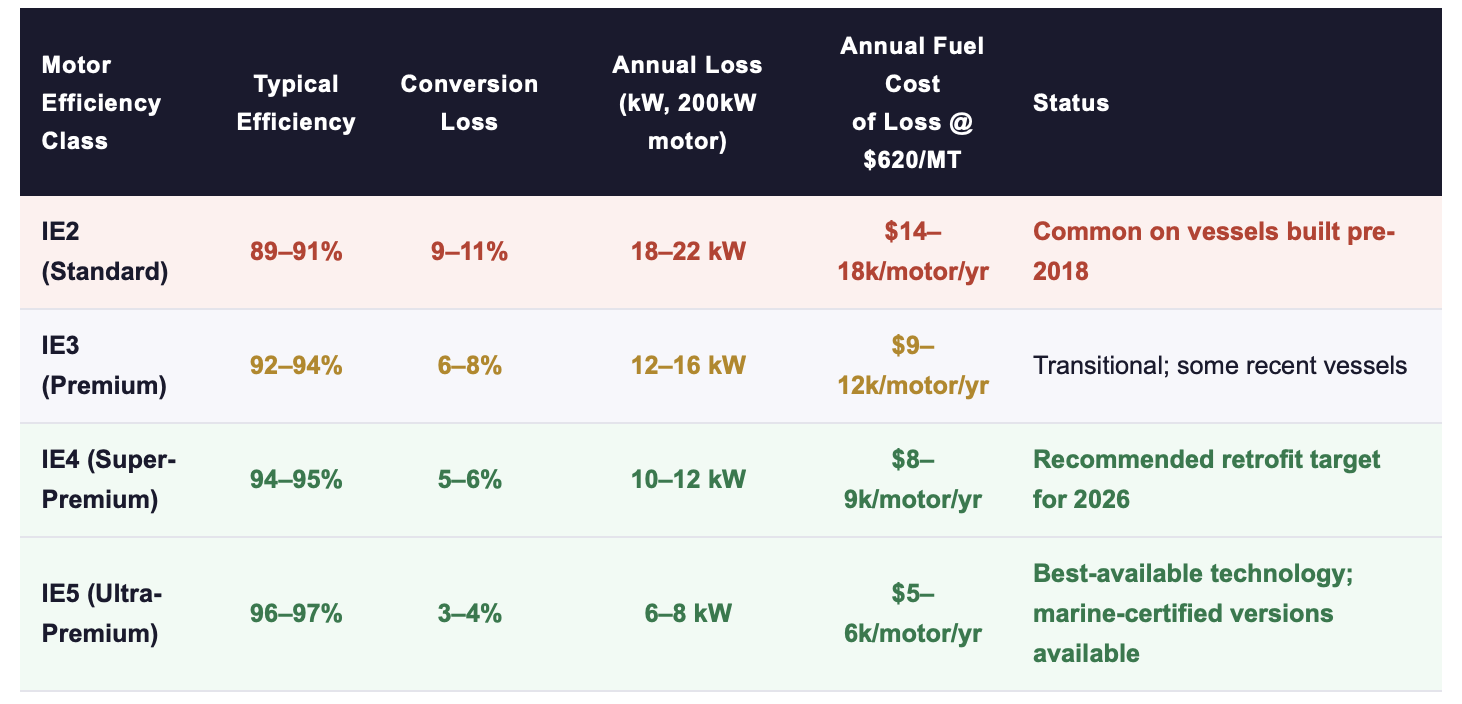
Motor efficiency data per IEC 60034-30-1 classification standard. Annual loss calculation for 200 kW motor, 8,000 hrs/year operation. Fuel cost at 180 g/kWh SFOC, VLSFO $620/MT.
The upgrade from IE2 to IE4 on a single 200 kW pump motor saves approximately USD 6,000–9,000 per motor per year. A Panamax vessel typically carries 12–18 motors in pump and fan service. Upgrading all of them to IE4/IE5 at drydock, combining the motor replacement with VFD installation in the same operation, delivers cumulative savings that approach the annual cost of the combined motor replacement programme within 24–36 months.
The critical implementation principle is combination: VFD installation without motor upgrade leaves motor conversion losses in place. Motor upgrade without VFD leaves throttling losses in place. Both together eliminate both loss mechanisms simultaneously, and the combined saving exceeds the sum of the individual savings due to reduced heat generation and improved system harmonic characteristics.
👉 Key Insight: VFD + IE4/IE5 is not two retrofits, it is one system solution. VFDs eliminate control losses; high-efficiency motors eliminate conversion losses. Neither is complete without the other. The combined system saving of 20–60% on pump energy is only achievable when both components are installed together. Partial installation is partial saving.
4. ROI Comparison: Why Pump Upgrades Lead the Drydock Package
The claim that pump and motor upgrades represent the highest-ROI component of a combined drydock package is testable against the data. The following comparison uses consistent methodology across the retrofit measures introduced in this series: annualised saving at USD 620/MT VLSFO, simple payback, and 10-year NPV at 8% discount rate, for a Panamax reference vessel.
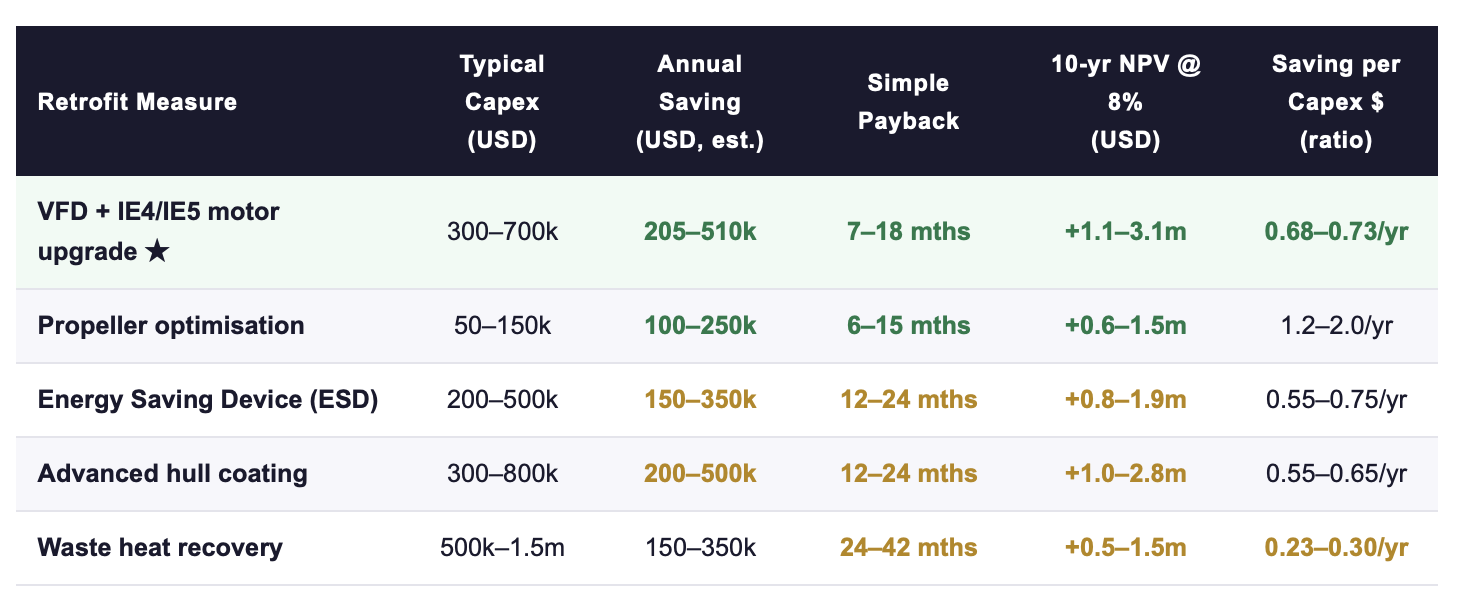
Sources: ABB Marine, 2025/2026; University of Piraeus, 2025; ABS, 2025; Wärtsilä, 2026. Panamax 65kt DWT reference vessel; annual saving at VLSFO $620/MT, 280 operating days. NPV at 8% discount rate, 10-year horizon. Ratio = annual saving divided by Capex midpoint.
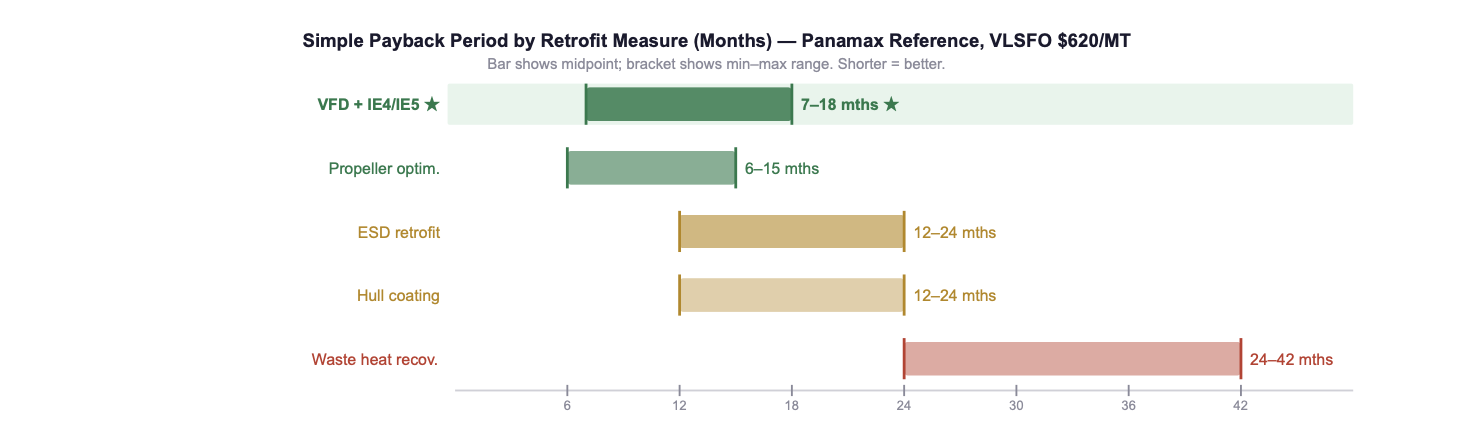
Fig. 2: Simple payback period by retrofit measure; shorter bar = faster payback = higher ROI. VFD + IE4/IE5 upgrade achieves the shortest payback of any substantive retrofit measure. Propeller optimisation is faster at lower Capex but delivers smaller absolute savings. Sources: ABB, 2026; University of Piraeus, 2025; ABS, 2025; Wärtsilä, 2026.
The ROI table and payback chart make a point that deserves explicit statement: propeller optimisation achieves a higher saving-per-Capex ratio than the pump/VFD package, because its Capex is lower. But propeller optimisation operates on a smaller base, it addresses propulsion losses, not auxiliary system losses. The pump/VFD package addresses a larger energy pool (50% of auxiliary load) and delivers a larger absolute annual saving. In a combined drydock programme, both are mandatory, propeller optimisation for the propulsion system, VFD/motor upgrade for the auxiliary system. They are not alternatives; they are complements addressing different loss mechanisms.
👉 Key Insight: In the combined drydock package, pump and motor upgrades are the efficiency multiplier for the auxiliary system, exactly as propeller and ESD optimisation are the multiplier for the propulsion system. Remove either component and the package delivers a fraction of its potential. Include both and the synergy exceeds the arithmetic sum. This is why the combined package consistently outperforms any individual measure by 20–35%.
5. Implementation: How to Include Pump and Motor Upgrades in the Drydock Package
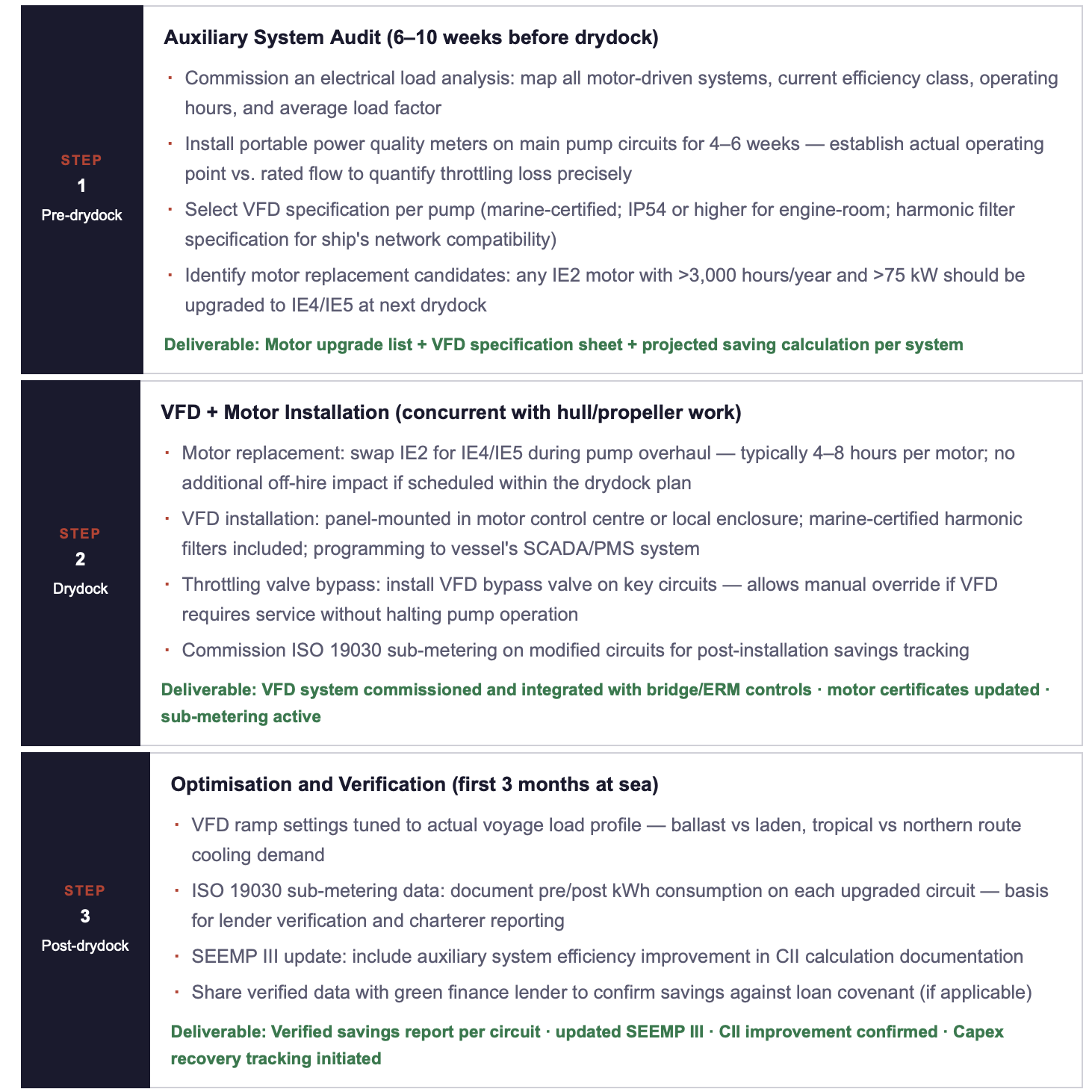
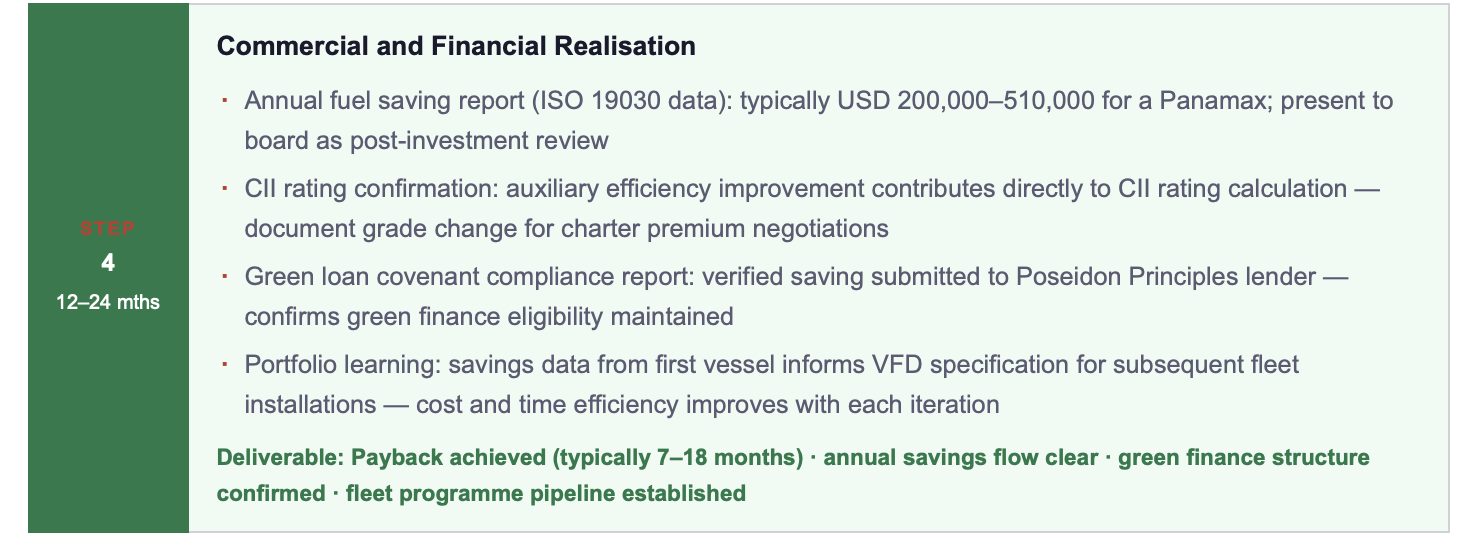
The implementation of VFD and motor upgrades is operationally simpler than most owners assume. The measures do not require hull work, are independent of propulsion design, and can be executed in parallel with hull and propeller work during the drydock without extending the off-hire period. The key is pre-drydock engineering preparation.
ACTION RECOMMENDATIONS
IMMEDIATE MEASURES (0–90 DAYS)
Install portable power quality meters on your highest-load pump circuits (ballast, seawater cooling) for 4–6 weeks before the next drydock, quantify actual throttling losses in kWh and USD before committing to VFD specifications.
Conduct an efficiency class audit of all motors >75 kW running >3,000 hours/year, any IE2 motor in that category is a payback-positive upgrade candidate at the next scheduled drydock.
Request a marine VFD specification from ABB, Danfoss Drives, or Siemens for the top three pump circuits by energy consumption, establish Capex range and confirm harmonic filter requirements for your ship's electrical network.
Confirm that SEEMP III includes the planned auxiliary system upgrade in the CII improvement trajectory documentation.
STRATEGIC COMMITMENTS (6–24 MONTHS)
Include VFD + IE4/IE5 motor upgrade as a mandatory scope item in every drydock specification for vessels with more than three years' remaining service life, the payback is virtually guaranteed at any bunker price above USD 400/MT.
Structure the pump/motor upgrade scope within the combined drydock package, hull, propeller, and auxiliary system work in the same yard call. This is where the 20–35% synergy multiplier is realised: sequential installations sacrifice it.
Develop a fleet-wide motor register: efficiency class, age, running hours, and next drydock window. This becomes the sequencing document for a portfolio-level auxiliary efficiency programme fundable as a single green loan facility.
Include ISO 19030 sub-metering in the VFD installation specification, the data it generates is required for lender verification, EU ETS compliance reporting, and charterer documentation simultaneously. It is not optional in 2026.
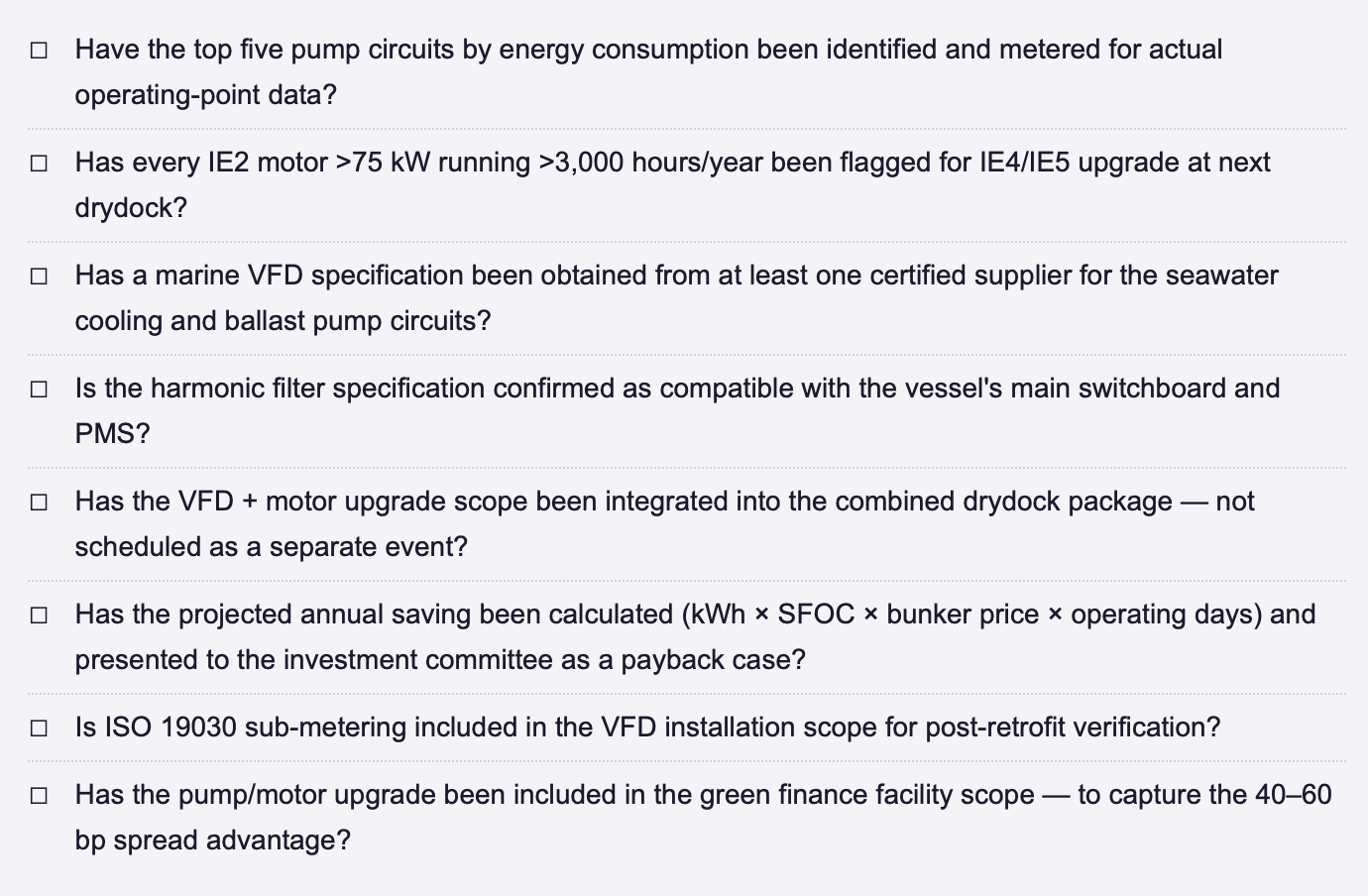
PUMP EFFICIENCY CHECKLIST: BEFORE THE NEXT DRYDOCK
FINAL THOUGHT
The hidden cost of inefficient pump systems is hidden only in the sense that it does not appear on a separate line in the OPEX statement. It is embedded in the bunker bill, invisible, accumulating, and entirely avoidable. The physics of the Affinity Laws make VFD retrofits one of the most reliable investments available in maritime efficiency: the savings are governed by fluid dynamics, not by market conditions. The Capex is modest. The payback is fast. The financing is available. The implementation is straightforward. The only thing that stands between most operators and USD 200,000–500,000 per vessel in annual fuel savings is the decision to include the pump and motor upgrade in the next drydock specification. That decision has a measured cost. The cost of not making it is the pump running against the throttling valve, every operating day, for the rest of the vessel's service life.
Have you completed a pump audit on your vessels, or do you have data from a VFD installation that confirmed, or surprised, the projected savings? Connect to share results or discuss the engineering specification for your vessel class. | This post is Part III of Week 17 in the Efficiency Before Fuel series.
REFERENCES
ABB Marine (2025/2026) VFD Retrofit Case Studies: Seawater Pumps and Engine-Room Fan Systems. Zurich: ABB.
ABS (American Bureau of Shipping) (2025) Retrofits for Energy and Emissions Improvement. Houston: ABS.
IEC (International Electrotechnical Commission) (2022) IEC 60034-30-1: Rotating Electrical Machines — Efficiency Classes of Line-Operated AC Motors. Geneva: IEC.
Marine VFD Market Reports (2025/2026) Variable Frequency Drive Adoption in Commercial Shipping: Market Analysis and ROI Benchmarks. Various publishers.
University of Piraeus (2025) Energy Saving Potential of Variable Frequency Drives on Ballast and Seawater Cooling Pump Systems in Commercial Vessels. Piraeus: Department of Maritime Studies.
Wärtsilä Corporation (2026) Lifecycle Optimisation Report: Total Cost of Ownership Analysis for Propulsion and Auxiliary Systems.Helsinki: Wärtsilä.
© René Grywnow, DBA · Strategic Intelligence Brief · April 2026 Efficiency Before Fuel Series · Week 17, Part III
Note: This article reflects my personal views based on industry experience and publicly available information. It does not constitute professional, legal, or investment advice and does not represent the views of my employer.
